|

Polygyny: A divine right or exception to the rule?
The discussion around polygyny is a contentious one, with polygyny being presented on the one
extreme as an unalienable right of a man to fulfil his sexual desires, and on the other extreme as
demonstrative of the inequality of women and men as espoused by Islam. But do these extremes exist
in practicality and what is the 'Islamic' position on polygyny?
Firstly jurists have differed on the allowance of polygyny, in the conditions
surrounding its permissability. Even if we excuse the fact that the
interpreted shari'a has traditionally reflected the patriarchal cultural norms of the
interpreters, surely the disagreement on this point by Muslim jurists points to
the fact that the unchallenged right to polygyny is not an eternal social precept
of the Qur'an.
The Prophet Muhammad, peace and blessings be upon him, saw fit to practice
monogamy for his entire marriage to Khadija, may Allah reward her, which lasted
twenty-five years. It was only after her passing
that the Prophet contracted a number of marriages for moral, humanitarian, political,
educational and legislative reasons.
It is instructive to turn to the Qur'an in order to understand the Qur'anic position on
polygyny. Surah an-Nisa (the Women) begins by establishing the creation of one soul and
it's (singular) mate:
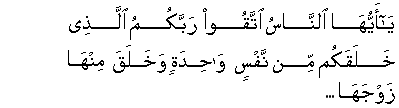
O Mankind! Be conscious of your Sustainer, who has created you out of one living
entity, and out of it created its mate, and out of the two spread abroad a multitude of men
and women (4:1, M. Asad translation)
In the second verse the Qur'an on rules regarding dealing with orphans.
In verse three it then makes a
condition:
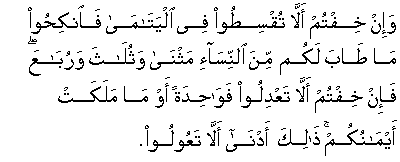
And [following on from the instruction regarding orphans in the previous verse] if you
have reason to fear that you might not act equitably towards orphans, then marry from among (other) women
such as are lawful to you - (even) two, or three, or four: but if you have reason to fear that you might
not be able to treat them with equal fairness, then (only) one - or (from among) those whom you
rightfully possess. This will make it more likely that you will not deviate from the right course. (4:3)
Asad's notes to the verse contain the following:
According to an interpretation suggested by 'A'ishah, the Prophet's widow, this refers to the (hypothetical)
case of orphan girls whom their guardians might wish to marry without, however, being prepared or able
to give them an appropriate marriage-portion - the implication being that they should avoid the
temptation of committing such an injustice and should marry other women instead (cf. Bukhari, Kitab at-Tafsir, as
well as Muslim and Nasa'i). However, not all of 'A'ishah's contemporaries subscribed to her explanation of this verse... 1
In the very same surah, Allah (swt) points out:
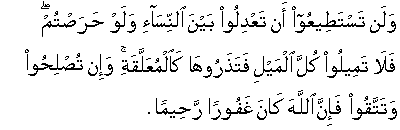
And it will not be within your power to treat your wives with equal fairness, however much
you may desire it... (4:129)
Some commentators have stated that this second definition of 'fairness' refers only to the love a man carries in his
heart that can never be equal, nevertheless if we turn to Asad's notes again:
This refers to cases where a man has more than one wife - a permission which is conditional
upon his determination and ability to "treat them with equal fairness", as laid down in
verse 3 of this surah. Since a man who is fully conscious of his moral responsibility might feel
that he is committing a sin if he loves one of wives more than the other (or others), the above verse
provides a "judicial enlightenment" on this point by making it clear that feelings
are beyond a human being's control: in other words, that the required equality of treatment relates only to
outward behaviour towards and practical dealings with one's wives. However, in view of the fact that a
man's behaviour towards another person is, in the long run, almost inevitably influenced by what he feels about
that person, the above passage - read in conjunction with verse 3, and especially in its concluding
sentence - imposes a moral restriction on plural marriages.
So rather than being the easy and unalienable right of a man to practice polygyny
whenever he may choose, the Qur'an states that it is reserved, in time and context,
for a particularised social setting.
Jurors have also differed on a woman's right to stipulate monogamy in her marriage contract, on the
basis that the Qur'an gives the right of polygyny (under certain circumstances) to men, and
thus women should not be able to forbid something which is permissible. It can be argued
however that the woman is not making a right forbidden, she is simply stipulating the
conditions under which she is willing to remain married to the future husband. If he wishes to
practice the 'right' of polygyny, he may still do so, however she should not be constrained to
remain married to him herself. At the very least if a man has a God-given right to
take up to four wives doesn't a woman have a God-given right to receiving
justice and fairness from her husband and that she should be able to stipulate how she
understands that concept of justice and fairness?
Nevertheless some scholars have put forward arguments to defend the (restricted) practice of
polygyny, that have sometimes been overlooked. The Qur'an has more to say on the
topic of marriage than simply 'allowing' polygyny. Both women and men are counselled to act in
particular ways towards their spouses. In reference to the closeness of intimate relations that
husbands and wives are called to foster for each other, the Qur'an says:
It is lawful for you to go unto your wives during the night preceding the [day's] fast: they are
as a garment for you, and you are as a garment for them. (2:187)
Furthermore, men are instructed:
O you who have attained to faith! ... consort with your wives in a goodly
manner; for if you dislike them, it may well be that you dislike something which God might
yet make a source of abundant good. (4:19)
If a husband is able to fulfil the Qur'anic stipulations that would permit him to
marry more than one wife, polygyny can offer a female dominated environment in which to raise
children. It can offer an extended family with the resources to provide continual, trusted, adult care,
allowing a woman time for her and her husband to be alone with other away from children and domestic duties. In the best circumstances it can also allow a
woman to be her own independent person: giving her time for her own interests, not having to
'merge' her own identity into her husband's in order to satisfy a co-dependent relationship. The
problems which can (and sometimes do) exist within polygynous marriages, such as jealousy, unfair
treatment of the wife, limited resources being stretched to their extreme etc. are also problems
that can (and do) exist in monogamous marriages. So the issue is not monogamy or
polygyny as a 'concept', but rather problems that arise when a human relationship of any sort is
neglected.
So, as there are times and conditions in which polygyny is practiced in society -
and it must be recognised that in some particular cases polygyny is supported, as with
the marriages of the Prophet - ultimately, however, the Qur'an restricts the practice:
the concept of polygyny itself is not necessarily eternally
prescribed without reference to the particular social conditions which cause its necessity.
And Allah (swt) knows best.
1 Asad, Muhammad. The Message of the Qur'an. (Gibraltar: Dar al-Andalus Ltd., 1984), p101.
top
|